



Tesla’s New Roadster Reignites the Flying Car Dream: What Comes Next for Future Transportation?
On October 15, 2026, Elon Musk presented Tesla’s long-awaited next-generation Roadster at a demonstration held at a SpaceX facility in Texas. The event attracted worldwide attention after a prototype performed spectacular airborne manoeuvres using thruster technology. The demonstration renewed an important question: are flying cars finally moving closer to reality?
The dream of flying cars has fascinated humanity for generations. What once belonged mainly to science-fiction films is now inspiring engineers to rethink the future of personal transportation. Advances in electric propulsion, battery technology, automation, and aerospace engineering are bringing new possibilities into view.
On October 15, 2026, Elon Musk presented Tesla’s long-awaited next-generation Roadster at a demonstration held at a SpaceX facility in Texas. The event attracted worldwide attention after a prototype performed spectacular airborne manoeuvres using thruster technology. The demonstration renewed an important question: are flying cars finally moving closer to reality?
Although the Roadster demonstration was significant, it is important to distinguish a vehicle capable of brief airborne stunts from an aircraft designed for sustained, controlled flight.
Tesla Roadster: A New Chapter in Automotive Engineering
Tesla’s next-generation Roadster has been anticipated for years. At the recent demonstration, the company showcased a prototype that combined high-performance electric-car engineering with technology inspired by SpaceX.
According to reports from the event, the vehicle used a combination of a suction system and high-pressure gas thrusters to perform unusual manoeuvres, including launching into the air, rotating, and landing back on its wheels. Musk also highlighted the vehicle’s claimed acceleration, suggesting that it could reach 60 miles per hour in less than one second.
These demonstrations attracted attention because they suggest a new way of exploring vehicle performance beyond conventional road driving.
However, the Roadster should not yet be regarded as a fully functional flying car in the conventional aviation sense. The demonstration showed brief airborne movement rather than sustained flight between destinations. The final production vehicle’s capabilities will need to be confirmed through further testing and technical disclosures.
Tesla has indicated that production is planned for 2028. That timeline remains a future target, and the vehicle’s final specifications, availability, and regulatory status will be important to follow.
How Could Thruster Technology Change Vehicle Design?
Conventional cars rely on tyres and road surfaces to move. Aircraft, by contrast, must generate enough lift or thrust to overcome gravity and remain controllable in the air.
Thrusters can provide short bursts of force, potentially enabling specialised manoeuvres. However, making a road vehicle fly safely and efficiently requires much more than briefly lifting it off the ground.
Engineers must consider weight distribution, propulsion efficiency, stability, energy storage, heat management, and emergency control. A system capable of lifting a vehicle for a short demonstration does not automatically provide the range, endurance, or safety needed for practical air travel.
Tesla’s demonstration therefore highlights an intriguing engineering direction, but it does not resolve all the challenges involved in building a true flying car.
Electric Air Taxis Are Advancing Too
Tesla is not the only part of the transportation industry exploring ways to move people through the air.
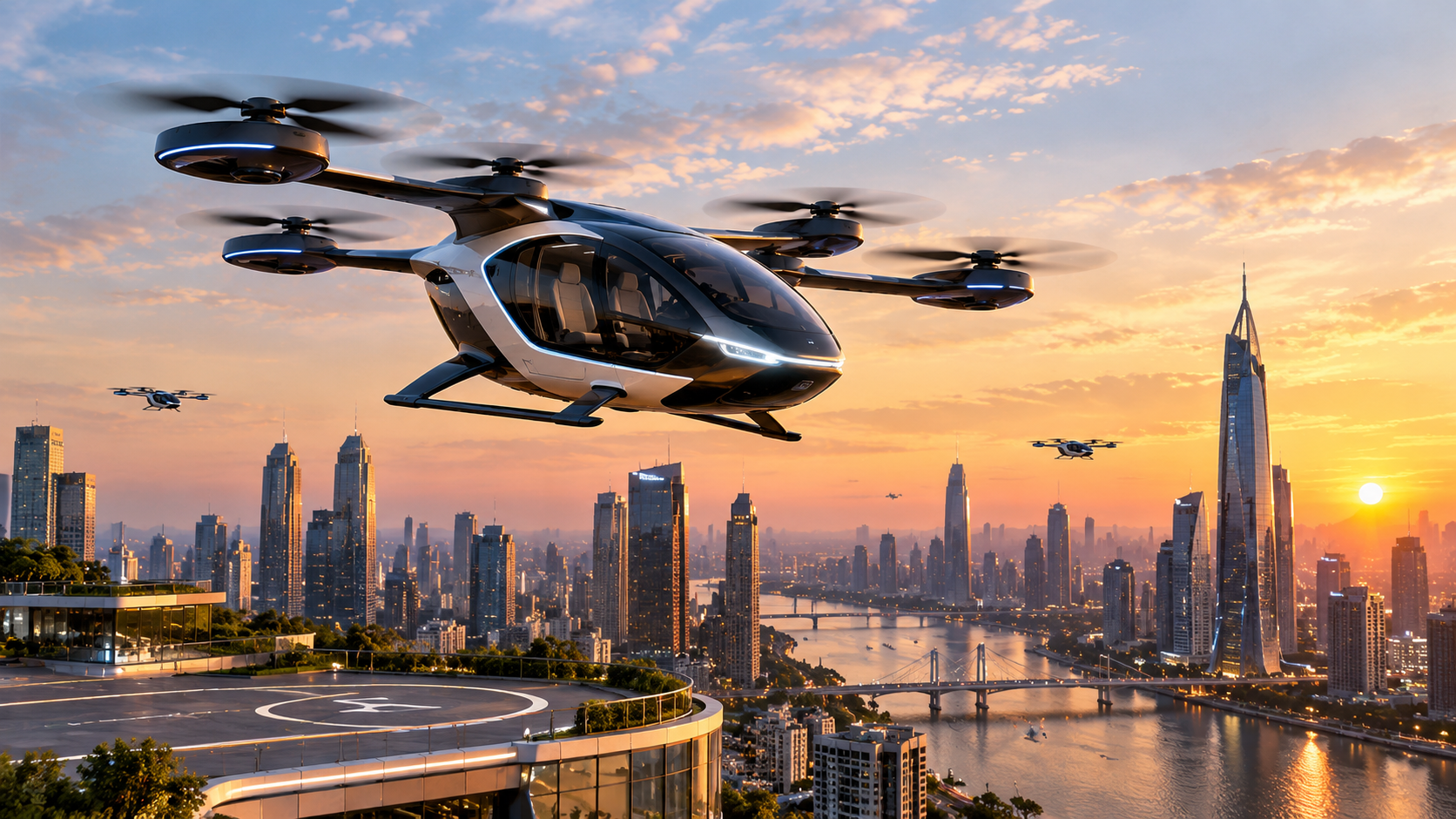
Electric vertical take-off and landing aircraft, known as eVTOLs, are being developed by aerospace companies for potential passenger, cargo, and specialised transportation services.
Unlike a road-going sports car equipped with thrusters, these vehicles are designed specifically for flight. Many use multiple electric rotors for vertical take-off and landing, with some incorporating wings for more efficient forward movement.
Potential applications include airport transfers, short urban journeys, emergency medical transport, and connections between locations that are difficult to reach quickly by road.
The development of eVTOL aircraft demonstrates that the future of flying transportation may emerge through several different engineering approaches rather than one universal flying-car design.
Could Flying Cars Reduce Traffic Congestion?
Traffic congestion is a major problem in many rapidly growing cities. Flying vehicles could eventually offer an alternative for selected journeys, particularly where time is valuable and suitable landing facilities are available.
For example, an air taxi might connect an airport with a business district or link two nearby cities without requiring passengers to travel along congested roads.
Nevertheless, flying cars are unlikely to eliminate traffic jams on their own. Passengers would still need ground transportation to and from take-off and landing locations. Weather, airspace restrictions, operating costs, passenger capacity, and safety requirements would also influence their usefulness.
A more realistic future may involve a combination of roads, railways, electric vehicles, public transportation, and specialised air services.
The Biggest Challenges Facing Flying Cars
Despite recent demonstrations and growing investment, several obstacles remain.
Safety and reliability: Vehicles must be able to manage propulsion failures, unexpected weather, and emergency landings.
Energy efficiency: Batteries and propulsion systems must provide sufficient power without making vehicles excessively heavy or limiting their useful range.
Regulation: Aviation authorities must determine how these vehicles can be certified and operated safely alongside conventional aircraft.
Infrastructure: Dedicated landing areas, charging facilities, passenger terminals, and air traffic management systems may be required.
Affordability: Advanced propulsion and aerospace-grade safety systems could make early vehicles expensive to purchase and operate.
Environmental impact: Electric propulsion can reduce direct emissions during operation, but the overall environmental benefit depends on electricity sources, battery production, noise, and energy consumption.
These challenges will determine whether flying transportation remains a specialised service or becomes accessible to a broader public.
What Could the Future Look Like by 2035?
The coming decade could bring significant developments in electric aviation and advanced mobility, although the pace of progress remains uncertain.
Specialised air-taxi routes may expand as aircraft receive approvals and supporting infrastructure develops. Advances in battery technology, navigation, automation, and manufacturing could improve the performance and economics of these services.
Meanwhile, demonstrations such as Tesla’s latest Roadster event may encourage further experimentation with propulsion and vehicle control.
However, a future in which ordinary consumers routinely drive their cars through the sky would require substantial advances beyond the capabilities demonstrated so far.
The most likely path may be gradual: specialised aircraft first, broader air mobility services next, and more ambitious hybrid vehicle concepts only if they prove practical and safe.
Final Thoughts: From Science Fiction to Engineering Reality
Elon Musk’s latest Tesla Roadster demonstration has brought renewed attention to the possibility of vehicles that can move beyond the road. Its unusual airborne manoeuvres illustrate how automotive and aerospace technologies might intersect in unexpected ways.
Yet a brief airborne demonstration is not the same as a practical flying car. Sustained flight, passenger safety, affordability, energy efficiency, and regulatory approval remain essential milestones.
The future of transportation may ultimately be shaped by several innovations working together: electric cars, advanced aircraft, autonomous systems, and better-connected transport networks.
Rather than asking only when flying cars will become common, the more important question is which technologies can deliver safe, reliable, and genuinely useful transportation.
The journey from an exciting prototype to an everyday transport solution is often long. The next decade will reveal how much of the flying-car vision can become a practical reality.
Editorial note: This article distinguishes reported events from future possibilities. Tesla’s demonstration and reported production plans are based on contemporary news coverage; future performance, commercial availability, and widespread adoption remain uncertain.
Sources:
- CBS News — Tesla Roadster debut and flying-car demonstration.
- Euronews — Report on the Roadster demonstration and thruster technology.
- Associated Press — Why the new Roadster does not yet mean practical flying cars are here.
Discussion
0 comments
Join the conversation
Sign in to leave a comment on this article.
No comments yet
Be the first to share your thoughts on this article.